Agentic AI in Organizations: Bottom-Up or Top-Down?
This is a continuation to my previous article ‘From Process Thinking to Agentic Thinking‘.
As organizations begin to integrate Agentic AI autonomous systems that can reason, plan, and act, one strategic question often raised in boardrooms and innovation labs:
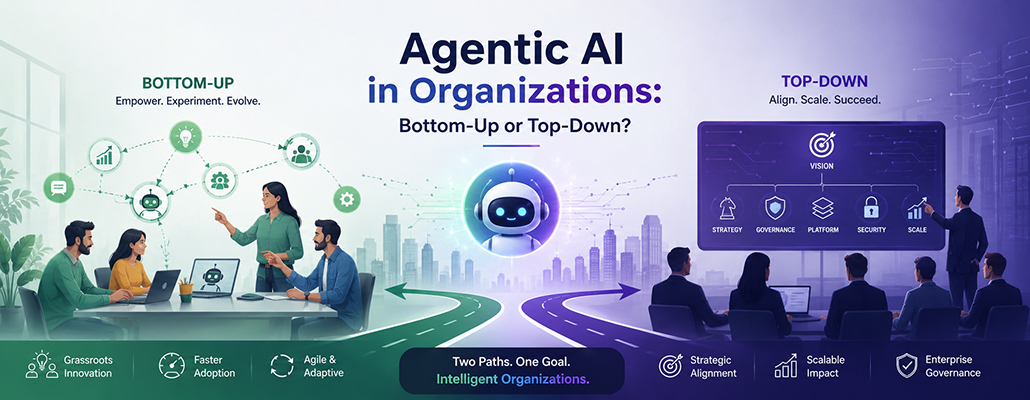
Do we start bottom-up, automating low-hanging tasks, or top-down, embedding autonomy into strategic business processes?
In order to truly scale the impact of artificial intelligence in the agentic era, organizations must fundamentally reset the way they approach AI transformation. This means moving away from fragmented, scattered initiatives that deliver isolated pockets of value, and instead committing to strategic, enterprise-wide programs that are deliberately designed to align with long-term business priorities.
It requires shifting the focus from narrow, one-off use cases that solve individual problems, toward reimagining entire business processes where AI becomes embedded as a core enabler of efficiency, resilience, and innovation.
1) The Bottom-Up Approach: Quick Wins First
Bottom-up strategies focus on automating repetitive, bounded functions like customer service triage, HR onboarding, or compliance checks.
Strengths of this approach:
- Delivers fast ROI and measurable efficiency gains.
- Builds organizational literacy around agentic systems.
- Creates trust by showing autonomy in safe, low-risk domains.
Risks:
- Can lead to fragmented ecosystems if governance isn’t standardized.
- Harder to align with enterprise strategy later.
2) The Top-Down Approach: Governance First
Top-down strategies begin with strategic domains such as compliance, finance, supply chain, and embed autonomy into core processes.
Strengths:
- Ensures alignment with enterprise goals and regulatory frameworks.
- Enables cross-functional governance from the outset.
- Scales more sustainably across functions.
Risks:
- Slower initial deployment.
- Requires strong executive sponsorship and mature data infrastructure.
3) The Hybrid Governance Model: Emerging Best Practice
The most effective organizations are blending both approaches:
- Top-down framing → Define strategic domains where autonomy is safe and valuable.
- Bottom-up pilots → Deploy agents in those domains to learn, measure, and refine.
- Governance loop → Feed pilot insights back into enterprise-level AI policy and architecture.
This creates a continuous discovery-to-deployment cycle, echoing Six Sigma’s Discovery phase, a structured exploration before execution.
According to Mckinsey – By automating complex business workflows, agents unlock the full potential of vertical use cases. Forward-looking companies are already harnessing the power of agents to transform core processes.
As referred by GenPact – Process intelligence has played a significant role in every wave of enterprise transformation. It started with process improvement through Lean Six Sigma (LSS), continued through the automation and analytics eras, and is now just as relevant as we enter the autonomous age powered by Agentic Ai Systems.
IBM – Agentic AI Governance Playbook outlines governance-by-design principles, highlighting the need for hybrid approaches that balance speed vs. control and innovation vs. predictability.
Key Takeaway
Agentic AI isn’t just automation — it’s governed autonomy. Organizations that balance experimentation with oversight will lead the next wave of intelligent enterprise transformation.
How do you see the hybrid (top-down + bottom-up) governance approach impacting your organization’s AI strategy?
Originally published on LinkedIn: https://www.linkedin.com/pulse/agentic-ai-organizations-bottom-up-top-down-chaya-pamula-ch4yc/
Hyperlinks: ‘From Process Thinking to Agentic Thinking‘