From Process Thinking to Agentic Thinking – Bridging BPM and the Age of AI Agents
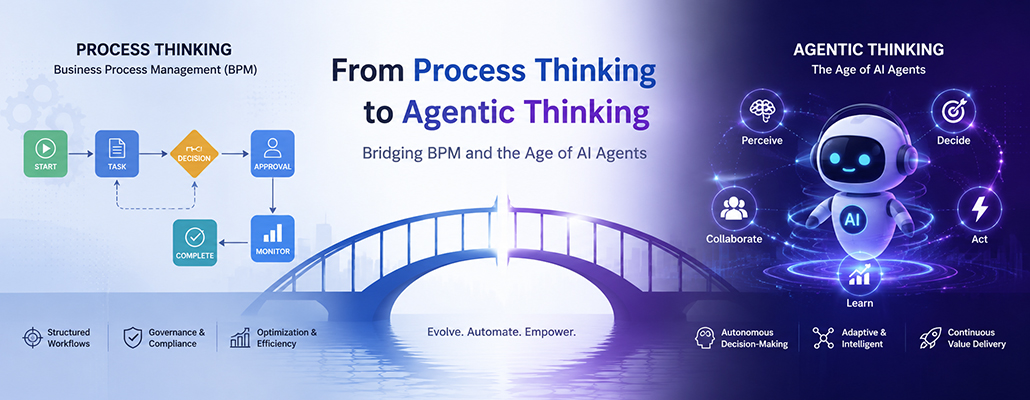
There have been several discussions around how Business Process Management (BPM) intersects with the rapidly emerging field of Agentic AI; systems that can reason, plan, and act autonomously. Many thought-provoking articles and research papers explore how process rethinking, governance, and automation are converging to shape the future of intelligent enterprises.
As organizations rush to embrace AI, one of the most transformative yet least understood shifts underway is the rise of Agentic AI, systems that don’t just execute instructions but can reason, plan, and act autonomously within defined boundaries.
This evolution challenges decades of process design logic. But if you come from the world of Business Process Management (BPM) or Process Re-engineering, you may be closer to mastering this shift than you think.
Rethinking Business Processes for the Age of Agents: From automating processes to automating intelligence
For decades, BPM has helped organizations streamline workflows, eliminate waste, and enforce governance. The logic was clear: map the process, define roles, and automate where possible. The rise of Agentic AI marks a turning point in how organizations think about automation and intelligence. We’re moving beyond task automation; toward systems that reason, plan, and act within well-designed boundaries.
Here’s how the two worlds align:
Traditional BPM Focus
- Process Modeling & Decomposition – define tasks and flows
- Process Mining & Discovery – analyze logs to find bottlenecks
- Governance & Controls – approvals, SLAs, audits
- Continuous Improvement – periodic review and optimization
- Stakeholder Management – communication and adoption
Agentic AI Evolution
- Agent Responsibilities & Goals – define objectives, constraints, and allow the agent to plan
- Agent Telemetry & Traces – track reasoning paths, decisions, and state transitions
- Guardrails & Oversight – constraints, human-in-the-loop gates, explainability, kill-switches
- Adaptive Loops – self-tuning agents that learn and improve within safe bounds
- Trust & UX for Autonomy – design transparency, confidence indicators, and escalation paths
In essence, AI compels a deeper, more radical version of process rethinking: rather than simply automating a reengineered process, one may need to rethink the process definition itself to suit autonomous, goal-driven agents.
How BPM Skills Can Transition to Designing AI Agency
If you’re a BPM practitioner — a process analyst, designer, or manager — you already bring a valuable mindset, method, and toolkit. But shifting to designing agentic AI systems requires adding or adapting certain skills. Below are a number of mappings and a developmental roadmap.
Core BPM skills and how they map with Agentic AI
Here are some core competencies in BPM and how they translate (or need extension) for agentic AI design:
Process modeling & decomposition
- In BPM, you break down business workflows into tasks, decision points, events, gateways, flows, subprocesses.
- For agentic AI, you’ll move from tasks to agent responsibilities, goals, decision logic, constraints, and define how agents coordinate, delegate, or merge objectives.
- You’ll need to design agent orchestration patterns (e.g., master–slave, peer-to-peer, hierarchical agents).
Process mapping, discovery, and mining
- BPM uses process mining, log analysis, event data to discover actual process variants, bottlenecks, rework loops.
- In agentic settings, you’ll use similar data but also simulation logs, state trajectories, event traces, and agent decision paths.
- You’ll need data literacy, the ability to assess data quality, to detect drift, and to instrument logging in a way that supports agent explainability and auditing.
Governance, compliance, controls, monitoring
- BPM designs control points, exception paths, approvals, SLAs, audit trails.
- For agentic systems, you must embed guardrails: constraints, fallback logic, human override thresholds, validation checkpoints, and audit logging of agent actions (not just outcomes).
- Governance becomes more complex: you may need meta-agents monitoring agents, anomaly detectors, or “supervisory” decision review systems.
Continuous improvement & measurement
- BPM uses KPIs, feedback loops, root cause analysis, periodic reviews.
- With agents, you can design adaptive loops: the agent collects metrics, detects drift, proposes or applies small adjustments, retrains parts of itself, or triggers redesigns — but you must bound those adjustments.
- You also need more simulation, “what-if” testing, sandbox environments for agent improvement.
Stakeholder alignment, change management, communication
- BPM practitioners are accustomed to working with business users, eliciting requirements, negotiating constraints, and aligning process change with culture.
- When designing autonomy, you’ll need to build trust, explainability, and transparent decision paths so stakeholders feel comfortable with delegating authority to agents.
Strategic process thinking, value orientation
- BPM often stresses focusing on value, outcomes, rather than just internal efficiency.
- In agentic AI you must define high-level objectives, trade-offs, costs vs benefit, and be selective where autonomy is sensible (versus human in the loop).
- You will be expected to think strategically about which processes should evolve toward autonomy, and in what phases.
Additional skills / mindsets you may want to acquire
To truly design agentic systems, BPM practitioners should cultivate:
- Machine-learning / AI fundamentals (especially planning, reinforcement learning, agent architectures, multi-agent systems).
- Algorithmic thinking about autonomy: being able to think in terms of state spaces, action spaces, reward functions, constraints, and safety boundaries.
- Explainability, interpretability, model debugging: designing agents whose reasoning can be inspected, audited, and corrected.
- Simulation and digital twin modeling: to test agent behaviors under varied conditions before deployment.
- Risk, ethics, fairness, alignment: ensuring agents do not over-optimize, drift, or generate unintended side effects.
- Software architecture & orchestration: understanding how agents integrate with APIs, services, microservices, data pipelines, and possibly “agent OS” layers (e.g. frameworks that coordinate agents).
- Governance frameworks for autonomy: meta-control layers, human override, fallback protocols.
- Monitoring & observability for agents: instrumenting agents much like you instrument distributed systems (metrics, logs, traces, anomaly detection).
So, a BPM professional is not starting from zero — but the scope and some toolsets need to evolve into the agentic domain.
Key Risks, Frictions & Cautions
While the parallel is promising, it’s important to note some of the key challenges and warnings:
- Over-automation / overreach: Letting agents act too freely can lead to unintended actions, boundary crossing, or undesirable side effects.
- Transparency and explainability: Agents may make decisions in opaque ways; achieving human-auditable rationale is difficult.
- Data and input quality: Agents depend on high-quality, consistent, timely data. Poor inputs lead to poor actions (“garbage in, agentic out”).
- Drift and feedback loops: Agents may optimize for locally good actions that degrade performance over time; need monitoring and retraining.
- Accountability and liability: Who is responsible when an agent errs or causes harm?
- Organizational acceptance and trust: Stakeholders must trust the agents; otherwise, they will resist delegating decision authority.
- Cost, complexity, and integration overhead: Agentic systems are more complex to build, maintain, and integrate; many pilot efforts may fail or be scrapped.
- Security and adversarial risk: Agents may be attacked, manipulated, or misled.
Hence, applying an engineering discipline, incremental pilots, strong governance, and fallback safety is essential.
- The shift toward agentic AI — autonomous, goal-driven systems — can be seen as a new phase of process rethinking, but deeper: not just redesigning workflows, but reimagining agency, goals, orchestration, governance, and continuous adaptation.
- Many of the conceptual foundations of BPM / BPR (decomposition, governance, value focus, monitoring, continuous improvement) remain highly relevant, but must be elevated to handle autonomy, decision-making, and multistage planning.
- BPM practitioners already possess many of the conceptual lenses (process thinking, stakeholder alignment, change management) needed — but must augment them with AI, algorithmic, governance, and observability capabilities.
- A staged, cautious, hybrid approach — starting with AI-augmented processes, pilot agents in lower-risk domains, embedding oversight, then evolving toward agentic orchestration — is a prudent path.
- Finally, given the risk of failed agentic projects (Gartner suggests > 40% may be scrapped by 2027) and Reuters, success demands strong linkage to business value, good data, disciplined governance, and continuous stakeholder trust building.
References & Resources
- Business Process Management: Concepts, Languages, Architectures — Mathias Weske
- BPM Skills in 2025 – Insights and Predictions from Brian Reale
- Gartner Predicts Over 40% of Agentic AI Projects Will Be Scrapped by 2027
- An Agentic AI for a New Paradigm in Business Process Development How AI is Set to Revolutionize Continuous Improvement
- Rethinking Digital Transformation for the Agentic AI Era
- From Reactive to Predictive: How AI Is Development How Continuous Improvement
Originally published on LinkedIn: https://www.linkedin.com/pulse/from-process-thinking-agentic-bridging-bpm-age-ai-agents-chaya-pamula-loyoc/